SurgeryEntry 04.1
The radical mastectomy
What was established
A surgical operation that followed from a theory of how cancer spreads dominated breast surgery for eight decades, until evidence finally replaced it.
The logic of the knife
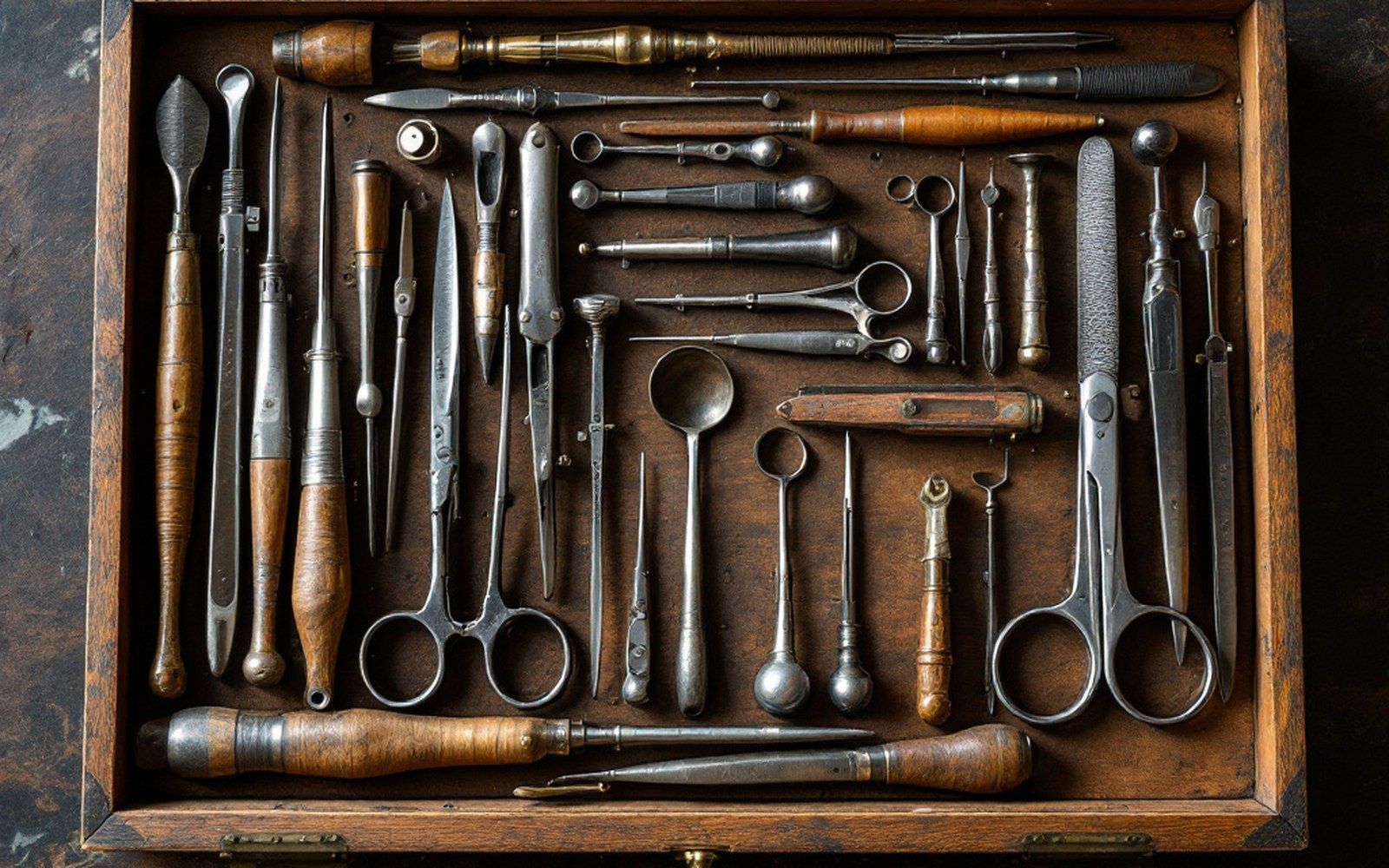
In 1894, William Halsted published the results of his operation on fifty patients at Johns Hopkins Hospital in Baltimore, Maryland. The paper established a procedure — en bloc removal of the breast, the pectoralis major and minor muscles beneath it, and the lymph nodes of the axilla — that would define breast surgery for most of the twentieth century. Halsted had not invented the idea of radical excision from nothing; his European contemporaries, among them the German surgeon Richard Volkmann and the British surgeon Joseph Lister, had pushed toward wider margins in the 1870s and 1880s. But Halsted systematised the logic, described his technique precisely and provided follow-up data, which made the operation teachable and, in time, nearly inescapable.
The reasoning behind it was Halsted's theory of spread: the idea that breast cancer moved centrifugally outward from its point of origin, travelling first through local tissue, then along lymphatic channels to regional nodes, then to the blood and distant organs. Under this model, the lymph nodes were not merely a staging post the surgeon might sample; they were a frontier, and the operation had to cross that frontier with the widest possible margin. Leave muscle behind and cancer would grow back along its fibres. Leave nodes behind and you would leave disease. The anatomy of the resection was the direct expression of a biological belief.
Lifted out of the flow
Chronology
- 1894Halsted publishes results of his radical mastectomy at Johns Hopkins, Baltimore
- 1920s onwardGeoffrey Keynes achieves comparable survivals with local excision and radium at St Bartholomew's Hospital, London
- 1940s–50sExtended radical mastectomy advocated (Urban, Memorial Hospital, New York), eventually shown to offer no survival gain
- 1950sVera Peters (Toronto) publishes retrospective data challenging radical surgery
- 1971NSABP B-04 trial launched by Bernard Fisher; results show no survival benefit of radical over lesser surgery
- Mid-1970sMilan I trial (Veronesi) compares radical mastectomy to breast-conserving surgery; equivalent survival
- Mid-1980sModified radical mastectomy becomes the norm; breast-conserving surgery validated as equivalent option
That belief made the radical mastectomy coherent, but it also made it extremely difficult to question. To argue for a smaller operation was, in effect, to argue that cancer did not behave the way Halsted said it did. Very few surgeons between 1894 and the 1950s were prepared to do that. The operation spread through American surgical training almost without formal debate, and its adoption in Europe was nearly as complete. Teaching hospitals from Oxford to Milan performed variants of the Halsted technique because that was what the textbooks and the senior surgeons prescribed.
Escalation and the first doubts
If Halsted's logic held, then a still-wider resection ought to produce still-better outcomes. That reasoning led, in the 1940s and 1950s, to the extended radical mastectomy — a procedure that added removal of the internal mammary lymph nodes, which run along the sternum, and sometimes the supraclavicular nodes as well. The American surgeon Jerome Urban at Memorial Hospital in New York was among its leading advocates. The extended operation was mutilating in proportion to its ambition, requiring resection of cartilage and portions of the chest wall to reach the internal mammary chain. Operative mortality was low in expert hands, but the morbidity was severe, and the procedure represented the logical terminus of the Halsted idea taken to its furthest point.
It was also, as later evidence would show, no improvement over the standard radical. The internal mammary nodes turned out to be a poor predictor of outcomes when removed rather than merely sampled. The null result of extended radicalism was one early sign that something in the underlying theory was wrong — but the sign was read slowly, because surgery of this era operated almost entirely on institutional authority and clinical impression rather than randomised data. Geoffrey Keynes, a British surgeon at St Bartholomew's Hospital in London, had already been achieving survivals comparable to Halsted's using wide local excision and interstitial radium implants from the 1920s onward, but his work attracted professional scepticism rather than adoption. The results did not fit the reigning model, and so they were filed away.

The crack that mattered came from within surgical epidemiology. Vera Peters in Toronto published retrospective comparisons in the 1950s showing that patients treated with simple mastectomy and radiotherapy had outcomes that tracked those of radical cases. Reginald Murley in Britain raised similar questions. The accumulation of such observations made it possible, by the early 1960s, to ask a question that had been professionally unsayable for seventy years: was the radical mastectomy actually saving lives that lesser surgery would not?
The trials and the answer
The mechanism that finally resolved the question was the randomised controlled trial — a design whose logic, when applied to this question, required that patients be allocated to treatment by chance, so that the two groups being compared differed only in what they received. Bernard Fisher, working through the National Surgical Adjuvant Breast and Bowel Project at the University of Pittsburgh, in Pittsburgh, Pennsylvania, built the trial infrastructure that could do this at scale.
The NSABP B-04 trial, launched in 1971, randomly assigned women with clinically node-negative breast cancer to radical mastectomy, total mastectomy with radiotherapy, or total mastectomy alone. With long follow-up, no significant difference in survival emerged between the three groups. This was not a marginal result. If removing the axillary nodes did not improve survival compared with simply treating or ignoring them, the centrifugal theory of spread that justified the operation was wrong in its most important claim. Fisher articulated the counter-model explicitly: breast cancer, he argued, was a systemic disease from an early point, and the question was never how much tissue the surgeon removed, but what happened to circulating cells that surgery could not reach.
It was also, as later evidence would show, no improvement over the standard radical.
Simultaneously, in Milan, Italy, Umberto Veronesi and his colleagues at the Istituto Nazionale Tumori were conducting the Milan I trial, which compared radical mastectomy against a procedure that preserved the breast entirely in patients with small tumours. The two arms showed equivalent survival. When the Early Breast Cancer Trialists' Collaborative Group — the Oxford-based consortium that pooled individual patient data from trials worldwide — later performed its systematic overviews, the equivalence held across thousands of cases.
The radical mastectomy did not vanish overnight. It remained in use through the 1970s and into the early 1980s in many centres, partly from institutional inertia and partly because the trials needed time to generate follow-up long enough to be persuasive. But by the mid-1980s, the modified radical mastectomy — which removes the breast and nodes but spares the pectoralis muscles — had become standard where mastectomy was still indicated, and breast-conserving surgery had been validated as an equivalent option for appropriate tumours. The operation Halsted described in 1894 had endured for eighty years not because evidence sustained it, but because theory had, and theory proved a poor substitute.

Lifted out of the flow
What the operation removed
- Entire breastthe fundamental unit of resection in every version
- Pectoralis major and minor musclesremoved en bloc in the Halsted radical; spared in the later modified radical
- Axillary lymph nodescleared to the apex of the armpit in the standard radical
- Internal mammary nodes, costal cartilage (sometimes)added only in the extended radical from the 1940s–50s
Elsewhere in surgery
- Halsted's theory of spreadThe operation followed from a theory about how the disease travelled, and when the theory turned out to be wrong the operation went with it.
- Conserving surgeryRemoving less tissue was resisted for a long time and then shown to give the same result, which took trials rather than argument.
- The axillaHow much of the armpit to remove was its own long argument, with real consequences for the arm afterwards.